Something weird happens around 40 for a lot of women. Okay not weird, but frustrating. You eat the same way, maybe even eat less, and still things just... shift. You feel heavier without eating more. More tired without doing less. And nobody really explains why this happens.
My friend Dana is 44 and she called me sometime last fall, maybe September, totally confused. She said she hadn't changed what she ate, still doing her same thing, but her body felt completely different. More puffy. More tired. Less like herself. And she was eating what she thought was a healthy diet. Lots of vegetables, not too much junk food, watching portions.
The issue? She was probably eating like 55 grams of protein a day. Maybe 60 on a good day.
The Part Nobody Tells You
That's the thing nobody tells women. The protein requirements go UP after 40, not down. I know it seems backwards. You'd think after you stop being super active and your metabolism slows down you'd need less of everything. But no. What happens is your muscle tissue becomes less responsive to protein signals — there's a term for it, anabolic resistance — and you basically need more protein to get the same muscle-preserving effect your body did automatically at 27.
And then add in the hormone stuff. Estrogen fluctuates wildly in perimenopause and early menopause, and one of its jobs was helping with muscle protein synthesis. When estrogen drops, you lose that assist. So you're fighting the game on harder mode, basically.
The number that most researchers land on these days is around 1.6 to 2.0 grams per kilogram of bodyweight. For a woman who weighs 68 kilos that's somewhere between 109 and 136 grams a day. When I tell people this they sometimes think I'm being extreme but I'm not — this is what the evidence actually shows. A 2020 study in the American Journal of Clinical Nutrition confirmed that women over 65 needed at least 1.6g/kg just to maintain muscle during a calorie deficit. You want to stay ahead of that curve, not catch up to it later.
What 120 Grams Actually Looks Like
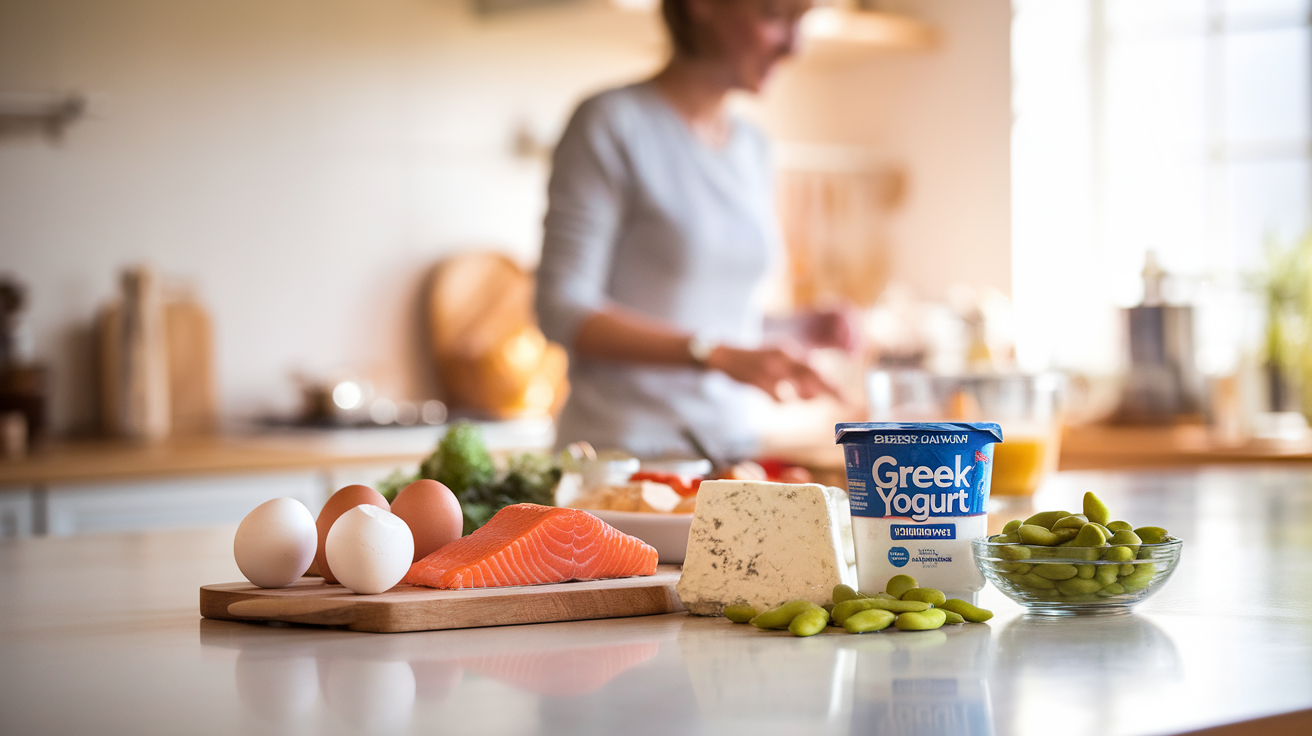
Here's what 120 grams looks like in a day, because I think seeing it concretely helps more than the math: three eggs and a big scoop of Greek yogurt for breakfast (somewhere around 36g combined). A chicken or turkey based lunch — say a bowl with some grains and greens — that's another 45g easily. Afternoon snack, cottage cheese with some berries, that's 20g. Dinner with salmon or ground beef, another 40g. That's 140g. You're not stuffing yourself. You're just being strategic.
The place women most often blow it is breakfast. Oatmeal with some fruit. Toast and coffee. Maybe a banana if they're in a rush. Those are all fine foods but they have almost no protein and you're setting yourself up to play catch-up for the rest of the day. Which almost never works — you end up slamming protein at dinner when your body can only really use 30-40g efficiently per sitting anyway. For ideas that actually front-load your protein, our high protein breakfast recipes section is a solid starting point.
The Foods That Actually Work
If you want actual food recommendations from someone who eats this way: cottage cheese is the one I'd push hardest. 25 grams per cup and it's like $2 at any grocery store. I eat it plain with some hot sauce, or with berries, or straight out of the container at midnight when I'm too tired to care. Canned wild salmon is the other sleeper pick — a 213g can runs about $2.50 at Trader Joe's and has 45 grams of protein plus all the omega-3s. Edamame is good, eggs are obvious and the cost per gram is unreal. One thing: get full fat Greek yogurt. The fat free version has more sugar and tastes like spackle.
For plant-based options, lentils and edamame are the reliable ones. Tofu works but you have to know how to cook it — press out the moisture, then pan fry it hard until it gets a crust. Mushy tofu is a meal-ruiner.
Don't Ignore The Lifting Part
I know this is a protein article. But eating more protein without any resistance training is like getting a great night of sleep but never actually using the energy for anything. Your muscles need a reason to rebuild. Twice a week is genuinely enough for most people. It doesn't have to be a whole production.
What changes dramatically when you combine adequate protein with consistent lifting: body composition improves even when scale weight doesn't move. You lose fat, build muscle, and end up stronger. That 145-pound woman who lifts and eats 120g of protein a day looks completely different from the same-weight woman who doesn't. Same number on the scale, totally different physique.
How Dana's Story Ended
Dana updated her approach starting in October. Not perfectly, she still has weeks where she doesn't hit her numbers. But she said by January she felt dramatically better — less of that weird puffiness, more energy, felt like her body was working with her again instead of against her.
If you're curious about putting this into practice day to day, the free 7-day high protein meal plan has everything already mapped out with gram counts — you don't have to think about it. And if you want to properly calculate your own target, the daily protein needs guide walks through the math for your specific weight and activity level.
The summary: protein requirements genuinely increase after 40. Most women are eating way less than they need. Closing that gap — slowly, consistently, with real food — is probably the highest-leverage nutrition change you can make right now.
It's not complicated. It's just specific.